The short version. The surgery takes an afternoon. The recovery takes about two months of genuinely restricted activity, then another couple of months of graduated return. Most owners find the confinement harder than the surgery, and most complications that happen at home are caused by a dog doing something normal too early. Your surgeon's written protocol overrides everything on this page.
What follows is the shape of a typical recovery after a bone-cutting procedure like a TPLO or a TTA. Lateral suture recoveries follow a similar arc, usually six to eight weeks of restriction, without the bone-healing radiograph. Protocols differ between surgeons and they differ based on what was found inside your dog's joint, so treat this as a map of the terrain rather than as instructions.
The Week-by-Week Arc
Days 1 to 3: home and groggy
Your dog comes home sedated, sore and probably not eating much. Expect a cone or a recovery suit, a strict medication schedule, and a leg that isn't being used. Toilet breaks happen on a short leash, in the smallest sensible patch of ground, and then straight back in. If your surgeon asked you to cold pack the knee, this is the window where it matters most. Some whining and restlessness in the first couple of nights is normal; a dog who seems to be in real, escalating pain is a phone call.
Days 4 to 14: the incision phase
Check the incision at the same time every day so you notice change rather than absolute appearance. Mild bruising and a little swelling are common. Redness spreading outward, discharge, heat, a bad smell or an opening edge are not. Skin sutures or staples usually come out around day 10 to 14. Many dogs start toe-touching in this window, which is encouraging and is not permission to do more. Keep the cone on. Dogs are astonishingly efficient at undoing two thousand dollars of surgery with ten minutes of licking.
Weeks 2 to 4: short, boring, controlled
Confinement continues. Leash walks are typically short and purposeful, five to ten minutes at a slow pace, building only as your surgeon directs. Straight lines on flat, non-slip ground. No stairs, no jumping in or out of the car, no furniture, no playing with other dogs, no off-leash time in a fenced yard. Weight bearing usually improves noticeably during these weeks, which is exactly when owners start to relax too early.
Weeks 4 to 8: longer walks, same rules
Walks lengthen on your surgeon's schedule. Your dog is probably using the leg well now and behaving as though the whole thing is over. The bone is still healing. This is the highest-risk stretch of the entire recovery, because a strong-feeling dog plus a relieved owner is how implants fail.
Around week 8: the recheck
After an osteotomy, your surgeon takes a follow-up radiograph to confirm the bone has healed before releasing your dog to more activity. This appointment, not your dog's mood, is what ends the confinement phase. Sometimes the answer is another two to four weeks, and that's not a failure.
Months 2 to 4: graduated return
Activity builds in stages: longer walks, gentle hills, controlled trotting, and rebuilding the muscle that wasted during confinement. Off-leash running and hard turns come last. Rushing this is the classic way to end up with a second surgery.
Months 4 to 6: normal life
Most dogs are back to their usual activity somewhere in this window. Some athletic dogs take longer to return to real sport. The knee has arthritis in it and always will, so long-term weight management and steady conditioning matter more from here on than they did before.
What "Restricted" Actually Means
Surgeons say restricted activity and owners hear take it easy. They are not the same instruction, and the gap between them is where complications live.
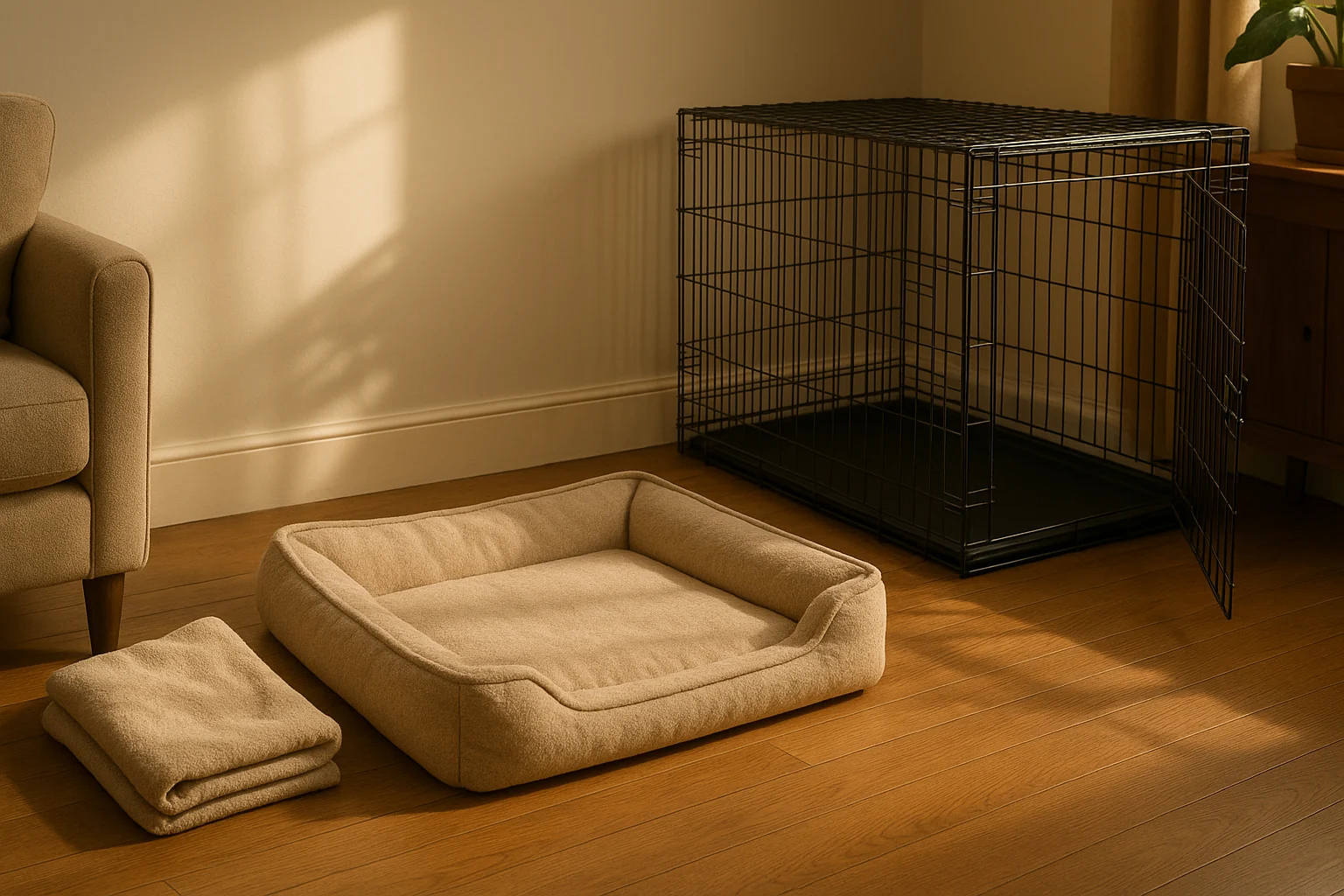
Restricted means your dog is in a crate, a pen or a small closed room whenever you're not actively watching them. It means leashed for every trip outside, including a fenced yard your dog has never once tried to leave. It means no stairs, no jumping onto or off anything, no greeting visitors at the door, no wrestling with the other dog in the house, and no slipping on hard floors.
ACVS puts the reason for this bluntly: postoperative care at home is critical, and activity must be restricted for several weeks to avoid complications with the implants or with healing. The complications it lists (implant breakage, bone fracture, meniscal tear) are exactly the injuries a single enthusiastic leap can produce.
One helpful reframe: you're not restricting a healthy dog, you're protecting a cut bone that's held together with metal until it becomes bone again. Two months is a short sentence for that.
Setting the House Up Before Surgery Day
Do this in the days before, not while carrying a groggy dog through the front door.
- The confinement space. A crate big enough to stand, turn and lie flat in, or a pen or small room. Put it where the family is. A dog isolated in a back bedroom for eight weeks has a much worse time than one confined in the middle of the household.
- Traction. Runners, yoga mats or rugs on every hard floor your dog crosses, especially the route to the door. Slipping on tile is a real cause of setbacks.
- Bedding. Something supportive and easy to wash, low enough to step onto rather than climb.
- A way to help a big dog. A support harness with a rear handle, or a towel sling under the belly, for stairs and for the car. Lifting a large dog by hand for eight weeks will hurt your back before it hurts theirs.
- Ramp or steps for the car, if car trips are unavoidable. Rechecks are unavoidable.
- Barriers. Baby gates at stairways. Furniture your dog jumps on blocked or made unappealing.
- The cone question. Have a backup. Many dogs do better with a soft recovery suit than a rigid cone, but not all of them, and finding out at 9 p.m. on day one is unpleasant.
Keeping a Bored Dog Sane
An under-stimulated dog invents their own stimulation, and the version they invent involves jumping. Mental work tires dogs out surprisingly well and costs the knee nothing.
- Feed from puzzles. Stop using a bowl for the duration. Snuffle mats, food-dispensing toys and frozen stuffed toys turn each meal into twenty minutes of work.
- Scent games at floor level. Hide a few treats around the pen or scatter kibble in a towel. Sniffing is genuinely tiring.
- Long-lasting chews, chosen for your dog's chewing style and supervised.
- Training that doesn't move the legs. Nose touches, chin rest, name recognition, gentle handling practice. Five minutes twice a day.
- Company. Sit on the floor next to the crate and read. Presence does a lot.
- Ask about anti-anxiety support. If your dog is genuinely distressed by confinement, that's a legitimate thing to raise with your vet. A dog frantically trying to escape a crate is a surgical risk, not just a sad situation.
Rehabilitation Is Worth the Money
ACVS notes that studies show physical rehabilitation can speed a dog's recovery and improve final outcomes regardless of which surgical technique was used, and that it should start immediately after surgery.
In practice that ranges from a formal program at a rehabilitation practice (underwater treadmill, therapeutic exercise, manual therapy) to a set of home exercises your surgeon or a certified rehabilitation practitioner gives you. Even the home version matters, because the muscle on the operated leg wastes fast during confinement and that muscle is part of what keeps the knee stable afterward.
Ask whether rehabilitation is included in your surgical package. It often isn't, and it's worth budgeting for separately.
Call the Surgeon, Don't Wait for the Recheck
Any of these deserves a phone call the day you notice it.
- Your dog stops bearing weight on a leg that had been improving, or suddenly gets much worse after a slip, a jump, or an escape from the crate.
- The incision opens, discharges, smells, or the redness is spreading outward rather than fading.
- New heat or swelling around the knee after the first week or two.
- Pain that isn't controlled by the medication you were sent home with, or a dog who won't settle, pants constantly, or cries when the leg moves.
- Not eating for more than about 24 hours, or repeated vomiting, particularly while on anti-inflammatories.
- Sudden collapse, pale gums, or a hard swollen abdomen with unproductive retching. That is an emergency in its own right and it is not related to the knee.
Surgical teams would far rather field a call that turns out to be nothing than see the same dog a week later.
After the Release: The Other Knee
One thing to carry out of recovery with you. ACVS states that 40 to 60 percent of dogs with cranial cruciate disease in one knee develop the same problem in the other, and that up to half of dogs do so within 12 to 18 months of diagnosis.
Two habits meaningfully change the odds you're playing with, and both belong to the years after recovery rather than the weeks during it: keeping your dog lean, and keeping them steadily conditioned rather than sedentary all week and athletic on Saturday. Neither is a guarantee. Both are worth doing.
If a limp appears on the other side, you already know what it might be, and you'll get in early instead of watching it for a month.
The rest of this guide:
This page describes the general shape of recovery after canine cruciate surgery. It isn't veterinary advice and it does not replace the written protocol your surgeon gave you, which accounts for what they found in your dog's joint. Where the two differ, follow your surgeon.
References
Sources for the claims that are more than general aftercare practice. The week-by-week staging below reflects commonly used protocols rather than a single published standard, which is why the page says repeatedly that your surgeon's protocol governs.
- American College of Veterinary Surgeons. Cranial Cruciate Ligament Disease. ACVS Animal Health Topics. acvs.org. Source for the criticality of postoperative home care, the complication list, the rehabilitation finding, and the 40 to 60 percent contralateral figure.
- Wemmers, A. C., Charalambous, M., Harms, O., & Volk, H. A. (2022). Surgical treatment of cranial cruciate ligament disease in dogs using tibial plateau leveling osteotomy or tibial tuberosity advancement: a systematic review with a meta-analytic approach. Frontiers in Veterinary Science, 9, 1004637. https://doi.org/10.3389/fvets.2022.1004637. Source for the reported complication profiles of the two osteotomies.