You already know what a parvo puppy looks like in the exam room. You've managed the hemorrhagic diarrhea, the severe neutropenia, the septic cascade. You know the survival numbers, and you know how much most families in this region can actually pay.
What you may not know is that the virus circulating in the area your clinic serves has been documented as unique in the world, and that a set of new therapeutic options, an antiviral with active distribution in Mexico, and a recent complication to a promising therapy have direct implications for how you manage these cases today.
This is a clinical update, not a basic science review. It covers what has changed, what is available, what it actually costs in Mexico, and where the evidence currently stands.
Your Patients Have CPV-2c. Exclusively.
This is not an exaggeration.
A five-year regional study in the Greater Guadalajara Metropolitan Area, which includes the Lake Chapala communities, found 100% prevalence of CPV-2c throughout the entire study period. No CPV-2a. No CPV-2b. No other location on the planet has published this level of sustained single-strain dominance.
The Jalisco CPV-2c strains carry three mutations in the VP2 protein (T226S, F267Y, and A440T) that structurally distinguish them from the strains against which most commercial vaccines were developed. This has a direct clinical consequence: in regions with CPV-2c predominance, a 34% vaccine failure rate has been documented. Owners who followed the standard 8-week vaccination schedule may be presenting puppies they believe are protected. They may not be.
César Pedroza-Roldán at the University of Guadalajara published the first complete CPV-2c genome sequences from Mexico in 2024 and has been mapping regional strains since then. His laboratory is forty minutes from most of you. The research infrastructure for this specific pathogen is local.
The Vaccine Your Patients Actually Need
If you are not routinely recommending Nobivac DP Plus, it is worth reconsidering why.
Standard CPV-2a and 2b vaccines have reduced efficacy against CPV-2c. Nobivac DP Plus uses a high-titer recombinant platform that generates mucosal immunity capable of overcoming maternal antibody interference, the same maternal antibody window that makes the standard 8-week schedule unreliable for many puppies. It vaccinates against CPV-2c, can be administered successfully at four weeks of age, and generates significant immunity within three days.
That four-week window matters. Most of the puppies dying in your region fall in the 8–16 week vulnerability period, when maternal antibodies have declined enough to permit massive environmental viral exposure but remain potent enough to neutralize a standard vaccine. A first dose at four weeks closes that window before it opens.
The barriers to getting Nobivac DP Plus to your patients are cost and distribution, not evidence. The evidence is solid. If you have a relationship with your Zoetis or MSD representative, this is a conversation worth having.
The CSU Outpatient Protocol: What Is Available in Mexico and What It Costs
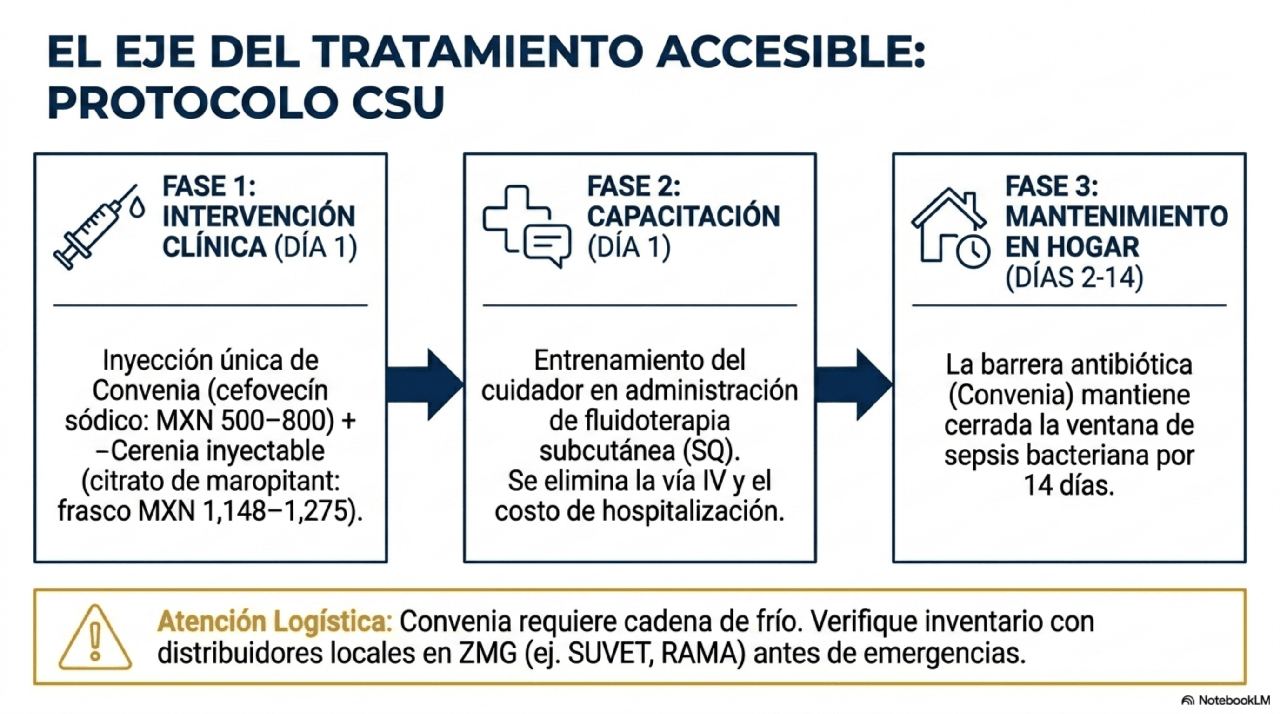
The Colorado State University outpatient protocol achieves 80–83% survival without hospitalization. Its three-drug structure is well documented. The practical question for your clinic is whether each component is accessible here.
Cerenia (maropitant citrate): Available in Mexico. Multiple national distributors carry it, including SUVET, ZonaVeterinaria, and RAMA. The 20 ml injectable vial has a retail price of approximately MXN 1,148–1,275. It is classified as a controlled medication requiring an authorized VRA with a current SADER/SENASICA certificate for purchase, a requirement you already meet.
Convenia (cefovecin sodium): Available in Mexico, with an estimated cost of MXN 500–800 per dose. Several distributors carry it nationally. One logistical note: because Convenia requires refrigeration, several online distributors restrict delivery to Mexico City and the Greater Metropolitan Area of the State of Mexico, with refrigerated shipping available by special arrangement. If your clinic is in Ajijic, Chapala, or another Jalisco community outside Guadalajara proper, confirm your supply chain before counting on same-day or next-day availability. Establish a direct account with a Guadalajara-based distributor who can maintain local inventory.
Subcutaneous fluids: No supply barrier. Train the caregiver during the appointment. This is the component that eliminates the primary driver of hospitalization cost.
The axis of the protocol is the Convenia injection. A vomiting puppy cannot reliably absorb oral antibiotics. A family without veterinary training cannot maintain an IV line. A single Convenia injection at presentation, followed by subcutaneous fluids the caregiver administers at home, keeps the bacterial sepsis window closed for fourteen days without any further intervention. For your lower-income clients, this is the difference between treatment and euthanasia.
TrueTect CPMA: The 93% Survival Rate and the Real Barrier
TrueTect CPMA, Elanco's monoclonal antibody targeting the CPV-2 VP2 protein, received USDA approval in late 2025. Clinical trials show 93% survival. It works by binding directly to the viral particle before cell entry, meaning it does not depend on the dog's immune system, the same immune system the virus has already been systematically dismantling.
A challenge study published in JAVMA in April 2024 reported 0% mortality in treated dogs, along with faster resolution of inappetence, vomiting, and lethargy compared to controls.
The barrier is price. A single dose costs approximately MXN 5,250–8,750*. Preliminary data from an Ohio shelter cohort suggests it is being used as an adjunct to established in-hospital protocols in US shelter medicine, where the institutional cost structure differs from a private clinic in Jalisco.
At current pricing, TrueTect CPMA is not a realistic option for most community cases. It is worth knowing it exists and watching whether the price evolves. The structural parallel to initial antiretroviral pricing in HIV is not a perfect analogy, but the pattern (available therapy, inaccessible price, pressure over time) is worth attention.
What Elanco has already done in the United States: Following USDA approval, Elanco donated significant quantities of TrueTect CPMA to US animal shelters at no cost and offered meaningful discounts to pet owners who requested it directly. This indicates the company has both the capacity and the willingness for differentiated access models when there is pressure and visibility. If you run a veterinary hospital with significant parvo case volume, or have ties to a university or research program, Elanco is a company worth contacting directly about compassionate access for Mexico.
| Virbagen Omega | TrueTect CPMA (Elanco) | |
|---|---|---|
| Survival rate | 85.7% | 93% |
| Mechanism | Immunomodulator: activates the dog's innate immune response via JAK-STAT | Direct viral neutralization: binds VP2 protein before cell entry |
| Doses required | 3 consecutive IV injections (7–8 vials for a 10 kg dog) | Single dose |
| Full treatment cost | ~MXN 23,000–27,000 at retail | ~MXN 5,250–8,750* |
| Average hospitalization | Standard duration | Reduced from 4 days to 2 days |
| Efficacy in neutropenic dogs | Limited, depends on the patient's immune system | Yes, does not depend on the dog's immune response |
| Availability in Mexico | Yes (Virbac Mexico, registration B-0042-025) | No, approved in US only (USDA, December 2025) |
| Temperature requirements | Standard cold chain: 2–8°C (refrigeration) | Deep freeze: ≤ −15°C. Requires −20°C freezer on-site. Once thawed, administer immediately (cannot be refrozen). Vials removed from freezer must be returned within 15 minutes if unused. |
On the import pathway: although TrueTect CPMA does not have SENASICA registration, there is a legal pathway for a clinic or veterinary hospital in Guadalajara to import it for clinical research purposes. The procedure is the SENASICA-01-047-C application: authorization for the import of samples for research and verification. The application is filed with the Dirección General de Salud Animal and has a maximum resolution period of 15 business days. The strongest mechanism is to partner with the University of Guadalajara as the reference importing entity, with the clinic's responsible veterinarian as principal investigator. This converts the first treated cases into publishable data: the first field evidence of TrueTect in a population with 100% CPV-2c prevalence, which is exactly the patient population you serve. A clinic with documented parvo case volume, equipped with a −20°C freezer, and backed by an academic agreement with UdeG is positioned to have legal product on-site in approximately four to six weeks from the date of application.
Virbagen Omega: Available, But Run the Dosing Numbers Before Quoting a Price
Virbagen Omega is authorized in Mexico, distributed by Virbac Mexico, and listed on Virbac's own Mexican website. The product has SAGARPA/SENASICA registration (B-0042-025). You can prescribe it today.
Here is the honest pricing picture.
Retail price in Mexico is approximately MXN 3,075–3,450 per vial (the MVZ discount price is around MXN 3,075). That sounds manageable until you apply the canine parvovirus protocol: 2.5 MU/kg IV once daily for three consecutive days. A 10 kg puppy requires 75 MU for the full course. At 10 MU per vial, that is 7–8 vials. Total treatment cost at retail: approximately MXN 23,000–27,000.
That is not very different from hospitalization cost. The drug is not a budget-friendly alternative at retail pricing.
What could change this calculation is institutional volume pricing. Virbac has negotiated reduced pricing with shelters and rescue organizations in other markets. If your clinic sees significant volume of community dogs, street rescue cases, or has a relationship with a local shelter, that conversation with your Virbac Mexico representative is worth having explicitly, not vaguely, but with specific case volume numbers. "We see approximately X parvo cases per year" is a different negotiating position than "we are interested in the product."
The Cytokine and IL-6 Research: A Promising Path With a Recent Complication
The 2026 cytokine data from Pedroza-Roldán in naturally infected dogs in Jalisco is the most region-specific finding in the current literature. Dogs with high interferon-gamma levels survived. Dogs with high IL-6 levels died at nearly universal rates. The pattern is consistent with the cytokine storm cascade documented in severe COVID-19 pathology, a dysregulated inflammatory response in which immune system overreaction, more than the virus itself, becomes the proximate cause of death.
This finding raises an obvious therapeutic question: if IL-6 is driving late-stage mortality, can IL-6 inhibition improve survival?
The answer is more complicated than it appeared a year ago.
A study published in September 2025 in Frontiers in Veterinary Science (Cornell University) tested tocilizumab, the IL-6 receptor antibody used in cytokine storm management in human ICUs, directly on canine IL-6 receptors in vitro. The result was mixed. Tocilizumab does bind the canine IL-6 receptor and does produce a measurable biological inhibitory response. But the canine IL-6 receptor binds tocilizumab with approximately two orders of magnitude less affinity than the human receptor. To produce an inhibitory effect comparable to what is observed in human macrophages, canine cells required substantially higher drug concentrations. The authors concluded that tocilizumab is likely not clinically viable in dogs at standard doses, and called for research into alternative monoclonal antibodies with better compatibility with canine IL-6 receptor structure.
This does not close the door on cytokine storm modulation as a therapeutic strategy for late-stage parvo in Jalisco. The IL-6 mortality correlation documented by Pedroza-Roldán is real and the mechanistic hypothesis remains solid. What it indicates is that tocilizumab specifically is probably not the right molecule, and that identifying an IL-6 receptor inhibitor compatible with canine biology is the next research step. The question is fundable as a veterinary research project, and the local cytokine data from Jalisco would be a compelling component of any funding application.
The Two Generic Medications That Might Already Work
Two off-patent human medications have shown in vitro evidence against canine parvovirus that has not yet been translated into clinical veterinary use, simply because market structure does not incentivize funding those trials.
Nitazoxanide: showed the highest inhibitory activity against canine parvovirus of all compounds analyzed in a screen of over 1,400 FDA-approved human drugs. Its proposed mechanism is cell cycle arrest: it temporarily blocks the cellular machinery the virus needs to replicate. It is an over-the-counter oral medication that costs approximately MXN 17–35* per day. What is needed is a pharmacokinetic study in healthy dogs: absorption, metabolism, excretion, safe dosing. Estimated cost: MXN 875,000–2,625,000*. If the result is positive, you get an oral antiviral for home use deployable across the region at near-zero cost per case.
Key research gap: Nitazoxanide has established safety data in dogs dating to 1985. The drug's original preclinical toxicology package explicitly included dogs and cats: single oral doses of up to 10 g/kg were tolerated without lethal toxicity, an unusually clean safety profile. What has never been done is an in vivo efficacy study in dogs for any viral indication, and no study against CPV. The strongest in vitro signal from 1,400 evaluated drugs, the confirmed mechanism, and a 40-year-old canine safety profile are waiting for a single pharmacokinetic study to open the door to a clinical trial.
Brincidofovir: a USDA-approved human antiviral that acts on DNA polymerase delta, the same replication mechanism used by both human parvovirus B19 and canine parvovirus. It has never been tested in a veterinary context. A proof-of-concept in vitro study would cost approximately MXN 175,000–525,000*.
Neither drug has been tested in dogs. Neither is something you can prescribe today based on current evidence. They are mentioned here because the veterinarians closest to this problem, in the region with the highest concentration of CPV-2c in the world, are in a privileged position to advocate for or participate in exactly this kind of research.
What You Can Do Today
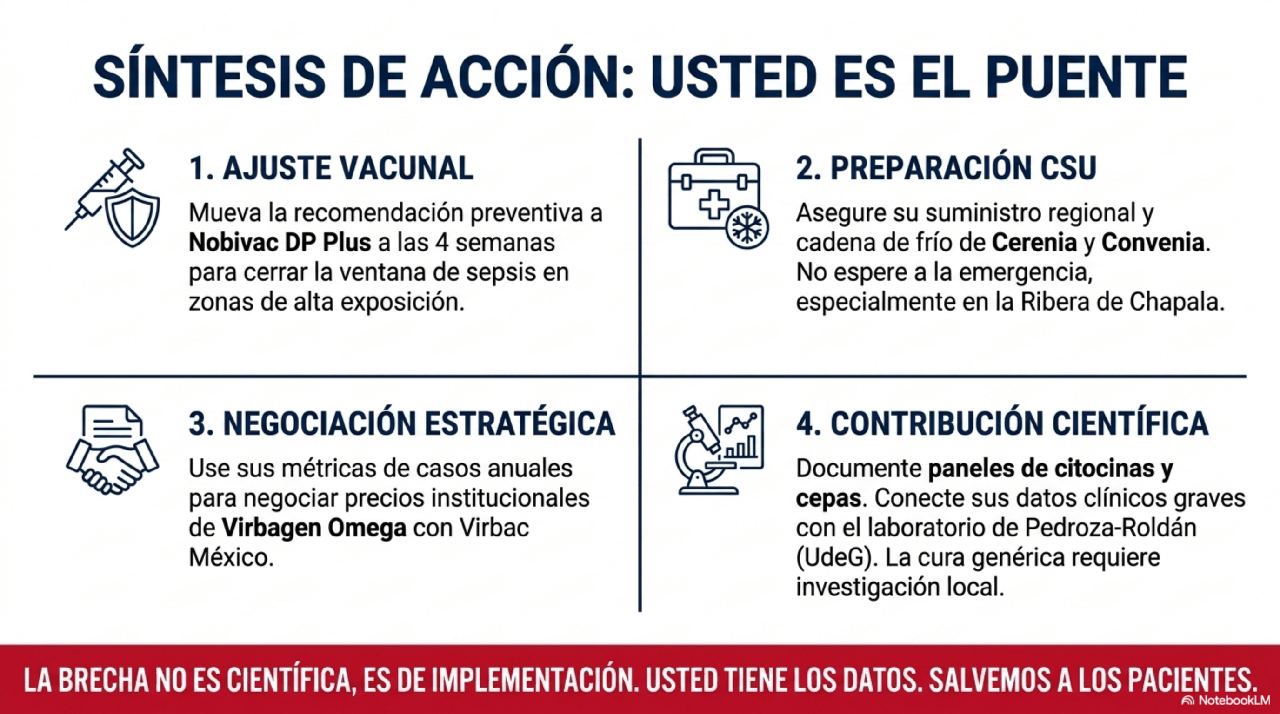
The following are concrete actions:
- Vaccination protocol: If you are not yet recommending Nobivac DP Plus at four weeks, consider it, especially for litters in high-exposure environments. Consult your distributor about current pricing.
- Outpatient parvo treatment: The CSU protocol is achievable with medications you can source in Mexico. Confirm your local supply of Cerenia and Convenia and establish cold-chain logistics before you need them urgently. Train the caregiver in subcutaneous fluid administration during the appointment. This protocol makes treatment accessible to clients who would otherwise have euthanasia as their only option.
- TrueTect CPMA, the import pathway: If your hospital has documented parvo case volume and access to a −20°C freezer, the SENASICA-01-047-C application in partnership with the University of Guadalajara is the most direct route to having legal product on-site in four to six weeks. Elanco Animal Health: elanco.com, 1-888-545-5973. The first treated cases become publishable data: the first field evidence of TrueTect in a 100% CPV-2c population.
- Virbagen Omega: If you see a consistent volume of parvo cases, contact your Virbac Mexico representative now, not when you are already facing a patient. Retail pricing makes the drug impractical for most community cases; institutional pricing may not. You will not know until you ask with specific numbers.
- The cytokine research: If you have the capacity to collect late-stage parvo case data (cytokine panels, clinical outcomes, strain identification), Pedroza-Roldán's work at UdeG is active and the regional dataset matters. It is worth making contact.
The Gap Is Not Scientific
The research base on this problem is more developed than most clinicians recognize. The mutations driving vaccine failure in your region are sequenced and published. The outpatient protocol is validated. The antiviral with the highest known inhibitory activity against this pathogen is a two-dollar oral medication available at pharmacies. The cytokine mortality marker has been identified specifically in your patients.
What is missing is not the discovery. It is the bridge between what researchers forty minutes away are publishing and what reaches the clinic, the owner, the puppy.
Evidence Library: Read the Studies Yourself
Here's the open-access research behind this page, hosted as downloadable PDFs. For the full library across parvovirus and distemper, see the Dog Health Research Hub.
Sabyrzhan et al. (2025). Co-infection of canine parvovirus and canine circovirus in dogs with gastroenteritis (Kazakhstan). Frontiers in Cellular and Infection Microbiology 15:1645697.
Pearce, Spibey, Sutton & Tarpey (2023). Development of a novel canine parvovirus vaccine capable of stimulating protective immunity in four-week-old puppies in the face of high maternal antibodies (Nobivac DP PLUS). Vaccines 11(9):1499.
Zhou et al. (2025). Overview of recent advances in canine parvovirus research: current status and future perspectives. Microorganisms 13(1):47.
Su et al. (2024). Transcriptional differential analysis of the nitazoxanide-mediated anti-canine-parvovirus effect in F81 cells. Viruses 16(2):282.
Zhou et al. (2019). Inhibitory effects of antiviral drug candidates on canine parvovirus in F81 cells (nitazoxanide identified from a screen). Viruses 11(8):742.
* Prices converted from USD to MXN using an exchange rate of MXN 17.50 per USD (May 2026). Dollar prices reflect published US rates; actual prices in Mexico may vary.
References
Every source cited above. Two of them are work from the University of Guadalajara group that we have seen presented but that is not yet published with a DOI, and they are marked as such rather than dressed up as citations.
- Venn, E. C., et al. (2017). Evaluation of an outpatient protocol in the treatment of canine parvoviral enteritis (the Colorado State University POPS trial). Journal of Veterinary Emergency and Critical Care, 27(1), 52 to 65. https://doi.org/10.1111/vec.12561
- Merbl, Y., Lopez Baltazar, A., Byron, J., Chan, D., Ehrlich, M., & Yu, Q. (2025). Tocilizumab binds to canine IL-6 receptor and elicits in-vitro inhibitory biological response. Frontiers in Veterinary Science. https://doi.org/10.3389/fvets.2025.1645414
- Lim, S., et al. (2024). Canine parvovirus monoclonal antibody (CPMA) challenge study, the clinical data behind the AVMA coverage of TrueTect. JAVMA, 262(4). Read at AVMA journals
- Pedroza-Roldán, C., et al. (2015). Genotyping of canine parvovirus in western Mexico. Journal of Veterinary Diagnostic Investigation, 27(1), 107 to 111. https://doi.org/10.1177/1040638714559969. The published background to the Guadalajara group's later work.
- Pedroza-Roldán, C., et al. (2024). First complete CPV-2c genomes from Mexico (T226S, F267Y, A440T), University of Guadalajara. Presented work, not yet indexed with a DOI.
- Pedroza-Roldán, C., et al. (2026). CPV-2c cytokine panel, low IFN-gamma associated with survival and high IL-6, IL-8, MCP-1 and IL-10 with poor outcome, University of Guadalajara. Presented work, not yet indexed with a DOI.
- Pricing figures are quoted from Mexican veterinary distributor lists as of May 2026, not from a published source. Confirm current prices with your own distributor.